


A smarter way to manage VPPs: How dynamic load shaping delivers consistent load reduction over long peak periods
Why utilities need smarter, more flexible VPPs
Standard demand response events remain one of the most effective tools utilities have for reducing load during a short peak period. But grid needs are evolving, and it is becoming increasingly difficult to predict when system peaks will occur. Utilities need VPPs that can deliver predictable, sustained output historically associated with generation resources. To meet those broader and more complex grid needs, VPPs must evolve beyond performance that is optimized primarily for sharp, single-hour peak periods.
This evolution aligns directly with the VPP Maturity Model, which provides a roadmap from basic demand response to VPPs that are schedulable, predictable, and capable of delivering load shapes that align with the increasingly complex requirements of grid operators.
Dynamic load shaping delivers a new level of VPP precision
Dynamic load shaping (DLS) is a meaningful step up the VPP maturity curve: it expands what a VPP can deliver by increasing consistency, improving controllability, and providing utilities with even greater confidence in program performance.
EnergyHub’s DLS capability builds on our proven work optimizing EV charging for distribution limits, wholesale costs, and customer rates. Now, we’re extending those same intelligent optimization capabilities across new device categories — introducing an optimization approach that delivers consistent load reduction across all thermostat partners, and ultimately batteries.
Powered by an AI‑driven optimization engine informed by data from more than 2.5 million devices, DLS dispatches devices based on each utility’s specific objectives. The result is a VPP that consistently delivers the multi-hour, consistent load reduction needed to keep the grid reliable. Rather than seeing performance taper in later hours, utilities can count on steady, predictable output across every hour of the event.
DLS doesn’t replace standard DR. It complements it, giving utilities the flexibility to choose the right strategy for the moment:
- Standard DR is most effective when a utility knows exactly when the peak will hit and wants to maximize load reduction in the first hour of an event.
- Load shaping events are ideal when the system peak is wide or uncertain. In these scenarios, utilities need consistent hour‑after‑hour load reduction without introducing new peaks from pre-event or post-event spikes in demand.
What DLS enables for utilities
DLS helps utilities meet four key operational objectives:
- Deliver consistent output during uncertain peak periods — Maintains a consistent load reduction so operators don’t need exact certainty about the timing of the peak
- Increase load reduction in later hours — Staggered scheduling improves third‑ and fourth‑hour performance by up to 25%
- Longer events with a better customer experience — Customers can participate for less time than the overall event, and time-of-use (TOU) hours are accounted for, reducing fatigue and improving retention
- Minimize transmission‑level impacts — By smoothing the increase in load typically caused by preconditioning and snapback before and after an event, DLS prevents unintended system peaks and protects critical infrastructure
These capabilities help utilities advance from Level 1/Level 2 “enhanced DR” to Level 2+ on the VPP Maturity Model, where VPPs can sustain output and support more complex schedules — laying the groundwork for Level 3 automated VPP operation.

How dynamic load shaping works
Behind the scenes, DLS is powered by:
- A mathematical optimization engine that sequences blocks of flexible capacity in a way that best meets a utility’s objectives.
- Thermal models driven by machine learning and trained on a utility’s historical event data to more accurately predict flexible capacity.
The optimization engine is multi-objective in that it optimally selects schedules to meet multiple goals selected by the utility:
- Maximize total load reduction during the event
- Minimize hour‑to‑hour variability of load reduction during the event
- Smooth preconditioning load ahead of the event
- Reduce maximum demand during the post-event recovery
The optimization model also accounts for constraints and guardrails it must follow, including:
- Program rules like earliest and latest dispatch times
- Customer comfort considerations like the longest duration a customer should participate
- OEM partner-specific constraints
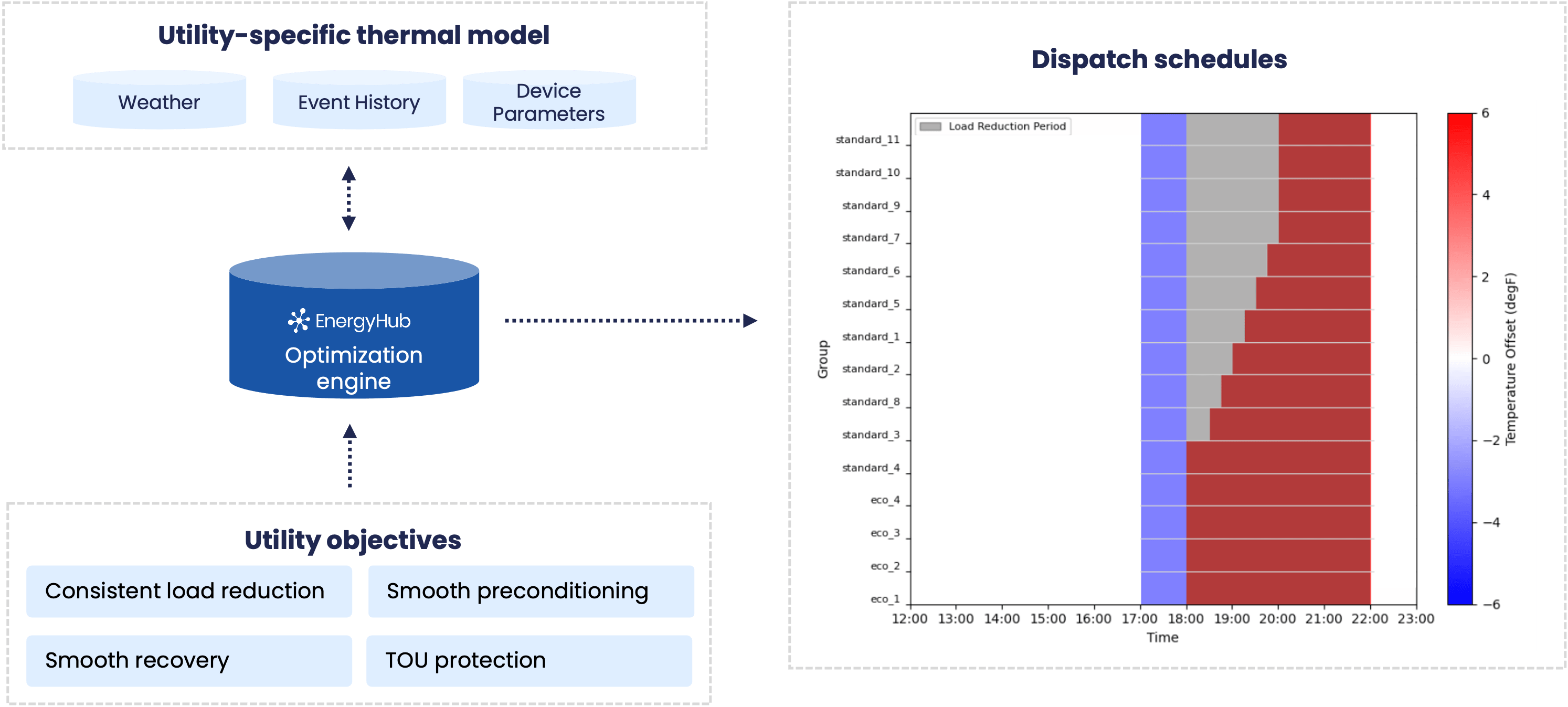
Fig. 1: EnergyHub’s optimization engine intelligently assigns dispatch schedules to deliver consistent load reduction.
Because every grid challenge is unique, DLS gives utilities the flexibility to tailor events to their operational goals without sacrificing predictability or customer satisfaction. A few common scenarios show how this plays out in practice:
1. Managing a long, uncertain peak
When a utility needs to navigate a wide or unpredictable peak, they configure a four‑hour event with pre‑ and post‑event smoothing. This approach delivers consistent output across the full window while avoiding late-hour drop-off and reducing the risk of secondary peaks.
2. Protecting TOU customers from bill impacts
When utilities serve a large share of time-of-use customers, they set objectives — such as consistent load reduction and no pre-cooling during the TOU hours —to ensure flexibility without creating unintended customer impacts.
3. Limiting customer impact during long events
When a utility requires a four‑hour system-wide event but wants to minimize customer disruption, they set participation limits — for example, limiting device participation to a two-hour maximum. This maintains operational reliability while supporting a better customer experience
Results
Here’s what we’ve seen in real‑world deployments:
- Delivered 25% more capacity by the third hour while still providing 90–95% of the average load reduction achieved in a standard DR event
- Up to 77% less hour‑over‑hour variability — compared to 20–30% degradation in typical DR events
- Substantially reduced post‑event snapback, helping utilities avoid costly secondary peaks

Fig. 2: 80,000 thermostats delivered consistent load reduction over 3 hours during a real-world deployment.
Advancing VPP capabilities — and building what comes next
Dynamic load shaping represents a meaningful step forward for utility VPP programs — helping portfolios move beyond simple load control toward resources that perform with the reliability utilities expect from generation assets.
As utilities advance along the VPP Maturity Model, DLS offers a practical, proven way to increase predictability, enhance confidence in utility programs, and rely on flexible load during critical periods.
What DLS delivers today
- Consistent load reduction across thermostat partners — Optimization for consistent load reduction is available across all thermostat partners in 2026, giving utilities a predictable, repeatable way to shape demand when it matters most.
- Consistent net load reduction from battery programs — Our battery portfolio delivers consistent net load reduction with Tesla batteries for the duration of an event, providing a steady, reliable source of grid flexibility backed by real performance.
Where we’re headed
We’re expanding DLS capabilities to include more battery partners and deliver consistent load reduction for longer durations. This next phase builds on proven performance today while opening new opportunities for deeper, more dependable VPP value.
We’re continuing to build these capabilities in partnership with utilities, shaping solutions that solve today’s challenges and prepare for what’s next. If you’re interested in seeing how DLS can support your portfolio, connect with us to explore how optimizing for consistent load reduction can meet your goals.